

Best Plug-In Hybrid Vehicles in Canada for 2025: Save Fuel Without Range Anxiety
Looking for an efficient ride that doesn’t rely 100% on charging stations? Plug-in hybrid vehicles (PHEVs) are the perfect middle ground between gas and electric. In 2025, Canadian drivers have more PHEV options than ever—great for reducing fuel use, lowering emissions, and ditching range anxiety. Here are the top picks for plug-in hybrids in Canada this year.
What Is a Plug-In Hybrid (PHEV)?
A plug-in hybrid vehicle (PHEV) uses both a gasoline engine and a rechargeable battery. Unlike regular hybrids, PHEVs can be charged at home or at public stations, allowing all-electric driving for short trips—and switching to gas when needed for longer drives.
- All-electric range: 30 to 80+ km (varies by model)
- Gas backup: No need to worry about charging infrastructure
- Eligible for federal/provincial EV incentives in Canada
Best Plug-In Hybrid Vehicles in Canada for 2025: Save Fuel Without Range Anxiety
More Canadians are switching to PHEVs in 2025 to balance urban efficiency with long-distance flexibility. With better battery range, smarter tech, and widespread rebates, these vehicles offer the best of both electric and gas-powered worlds—especially for drivers living in provinces with limited charging networks.
Top 7 PHEVs in Canada for 2025
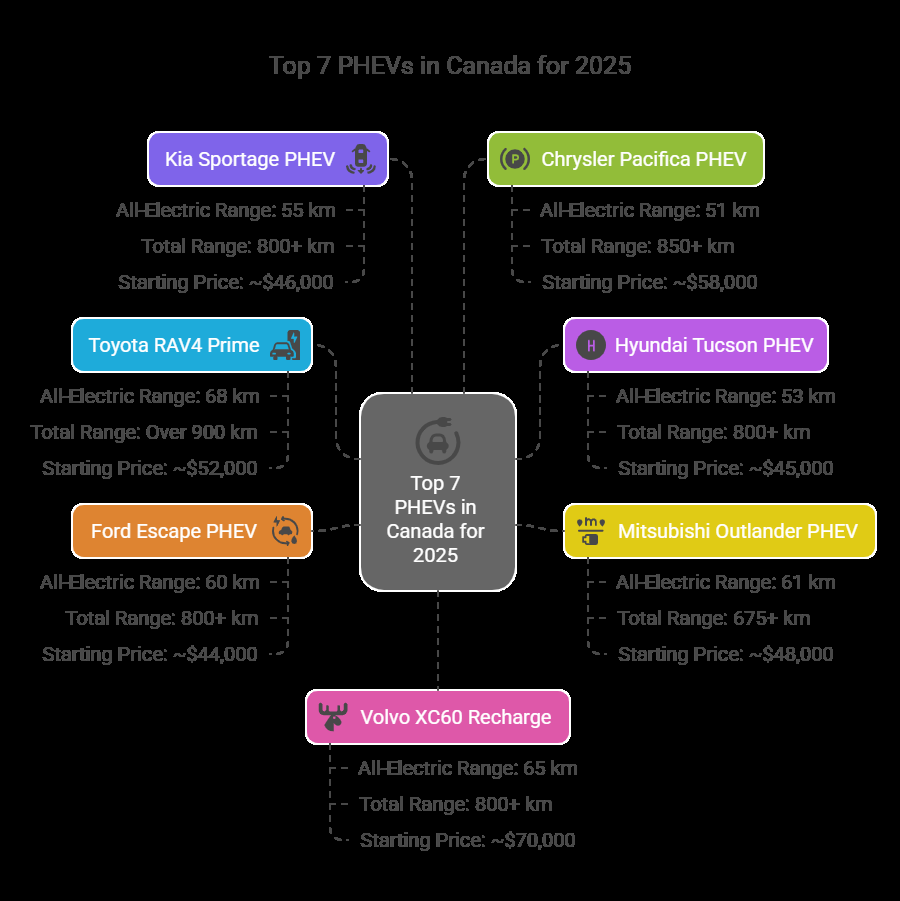
1. Toyota RAV4 Prime (2025)
- All-Electric Range: 68 km
- Total Range: Over 900 km
- Starting Price (before rebates): ~$52,000
The RAV4 Prime remains Canada’s most popular PHEV SUV. With blistering speed, standard AWD, and great electric range, it’s ideal for families and commuters. Qualifies for up to $5,000 in federal rebates and more in provinces like Quebec and BC.
2. Hyundai Tucson PHEV (2025)
- All-Electric Range: 53 km
- Total Range: 800+ km
- Starting Price: ~$45,000
A bold-looking SUV that’s packed with tech and value. Standard AWD, generous cargo space, and wireless Apple CarPlay make this a versatile and family-ready plug-in SUV.
3. Mitsubishi Outlander PHEV (2025)
- All-Electric Range: 61 km
- Total Range: 675+ km
- Starting Price: ~$48,000
Canada’s best-selling plug-in SUV for several years. With seating for 7, a long battery range, and fast charging, it’s ideal for larger families or those needing third-row flexibility.
4. Ford Escape PHEV (2025)
- All-Electric Range: 60 km
- Total Range: 800+ km
- Starting Price: ~$44,000
A compact and quiet plug-in SUV. The Escape PHEV doesn’t have AWD but makes up for it with smooth ride quality, great fuel economy, and a roomy interior.
5. Kia Sportage PHEV (2025)
- All-Electric Range: 55 km
- Total Range: 800+ km
- Starting Price: ~$46,000
Striking design, advanced infotainment, and strong warranty coverage. A rising favourite in urban and suburban areas looking for a reliable daily commuter with flexibility.
6. Chrysler Pacifica PHEV (2025)
- All-Electric Range: 51 km
- Total Range: 850+ km
- Starting Price: ~$58,000
The only plug-in minivan in Canada. Excellent for families who want EV efficiency with maximum passenger space and safety features. Great for school runs and long road trips alike.
7. Volvo XC60 Recharge (2025)
- All-Electric Range: 65 km
- Total Range: 800+ km
- Starting Price: ~$70,000
For luxury buyers, the XC60 PHEV blends Swedish craftsmanship with electrified power. Smooth, safe, and stylish—perfect for professionals and road trip lovers who want comfort without compromise.
PHEV Rebates in Canada (2025)
- Federal iZEV Program: Up to $5,000 off eligible PHEVs
- Quebec: Up to $2,500 provincial rebate
- BC: Up to $1,500 CleanBC rebate
- Newfoundland & PEI: Additional incentives may apply
Tip: Always check current eligibility lists at Transport Canada’s iZEV website.
Benefits of Driving a PHEV in Canada
- ✔ Use electric mode for daily errands or commutes (no gas)
- ✔ Switch to gas for longer trips (no charging stress)
- ✔ Eligible for HOV lanes in some provinces (e.g., Ontario)
- ✔ Lower emissions + lower fuel costs
- ✔ Provincial charging infrastructure is expanding
FAQs About PHEVs in Canada
Q1: How long does it take to charge a PHEV?
A: Most PHEVs take 3–4 hours on a Level 2 charger or 6–8 hours on a standard wall outlet.
Q2: What happens if the battery runs out?
A: The gas engine kicks in automatically, so you’ll never be stranded like in a full EV.
Q3: Do I still need to buy gas regularly?
A: It depends on how far you drive. Many PHEV owners use little to no gas for city driving but use it for highways and trips.
Q4: Can I charge a PHEV at home?
A: Yes! A regular 110V household outlet works, but a Level 2 charger (240V) is faster and recommended.
Q5: Is a PHEV better than a regular hybrid?
A: For drivers who can plug in regularly, yes. PHEVs offer better fuel savings and EV-only driving capabilities.
Helpful Resources
- Transport Canada – iZEV Incentive Program
- Plug’n Drive – PHEV & EV Education
- Natural Resources Canada – Charging Station Map
Explore more fuel-saving and plug-in models inside our Car Brand section—featuring the latest hybrid and electric options from top manufacturers available in Canada.
Complete Car Loan Guide for Canada & USA
Looking for the best auto loan rates? This guide covers car financing options in both Canada and the USA. Learn how to get low interest car loans, compare lenders, and apply online with ease.
Country-Specific Car Loan Guides
- Car Loan Guide – Canada (covers bank car loan offers and credit union car loans)
- Car Loan Guide – USA (includes auto loan refinancing and pre-approved auto loan tips)
Why Trust This Car Loan Guide?
We reference trusted resources like Ratehub’s Canadian car loan rankings and NerdWallet’s U.S. auto loan analysis. These comparisons provide real-time information on compare car loan rates and vehicle financing for bad credit.
How to Use This Guide
Step 1: Choose Your Country
Select Canada or USA for tailored details on online car loan application steps.
Step 2: Learn Eligibility
Check credit score requirements, down payment expectations, and loan terms for low interest car loans.
Step 3: Compare & Apply
Review lender offers, auto loan refinancing options, and repayment periods before applying.
Pro Tips for Smart Car Financing
- Check your credit score—higher scores unlock low interest car loans.
- Get a pre-approved auto loan—gives you more bargaining power.
- Compare car loan rates—across banks, credit unions, and online lenders.
- Watch out for markups—dealer financing may cost more than bank car loan offers.
Disclaimer: Loan terms and rates vary by lender, credit score, and location. Always confirm details directly with the financial institution before applying.


